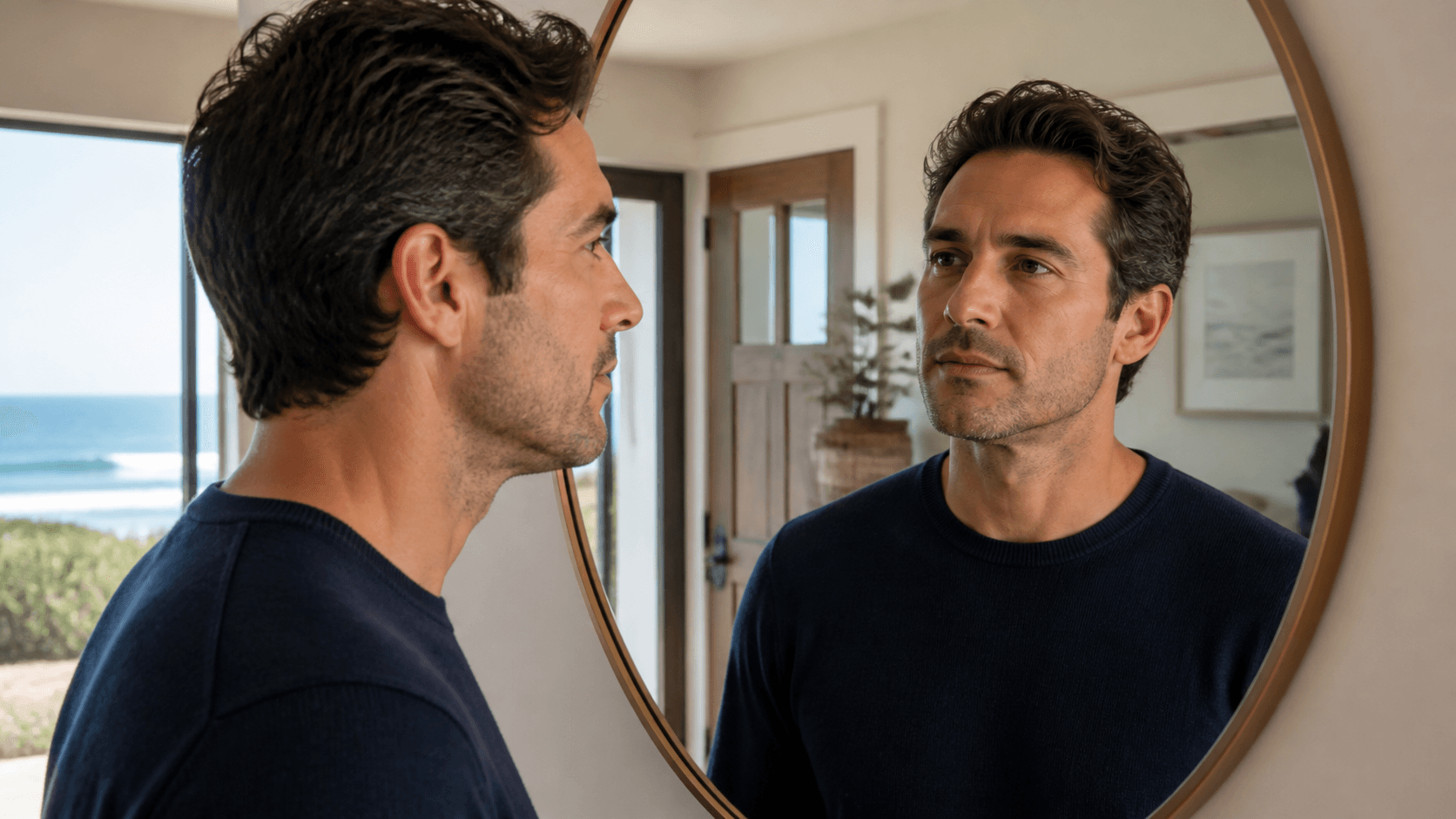
A nose usually looks crooked because the septum inside it is bent, the nasal bones lean to one side, or the tip points off center, often several at once and sometimes after an old injury. Straightening it generally means correcting the structure rather than shaving the most visible bump, and septoplasty for breathing does not by itself straighten the outside of the nose. Because most faces are slightly asymmetric, a perfectly straight line on a photograph may not look perfectly centered in real life.
Effective rhinoplasty therefore begins with structure and breathing, not simply shaving the most visible high point.
| What you see | Likely structure | What may correct it |
|---|---|---|
| The bridge leans to one side | Nasal bones | Controlled repositioning of the bones |
| A C- or S-shaped curve down the nose | Septum and middle vault | Septal straightening with support |
| The tip points off center | Tip cartilages or the front of the septum | Tip repositioning |
| One side blocked when breathing | Septal deviation or a narrow valve | Septoplasty or valve support |
| A bump on one side only | Irregular bone or cartilage | Selective smoothing |
Is the septum bent?
The septum divides the nasal airway and supports the bridge and tip. A deviation can push the external nose to one side and restrict airflow. Straightening it may require releasing curved cartilage, preserving a strong support segment, and sometimes rebuilding support with grafts.
Removing too much septal support can create collapse. The goal is not to make every piece perfectly flat, but to create a stable airway and a straighter external framework.
Are the nasal bones or cartilages off center?
Nasal bones may need controlled repositioning rather than simple reduction. The upper lateral cartilages form the middle vault and influence both dorsal lines and internal valves. A crooked tip adds another layer. Each component should be evaluated from the front, base, profile, and moving views.
The dynamic article on why a nasal tip drops with smiling shows how motion can reveal support issues that a frontal image misses. For men, male rhinoplasty should also preserve an appropriate bridge, projection, and feature identity.
Will my face look symmetric afterward?
Eyes, brows, cheek projection, jaws, and nostril bases are not perfectly level in most people. A straighter nose can improve balance without making the entire face symmetric. Swelling can also resolve unevenly for months, especially after structural correction.
Computer imaging can support communication, but it is not a guarantee. It should illustrate direction and proportion, including the relationship discussed in nose and chin profile balance.
Frequently Asked Questions
Can a crooked nose be fixed without breaking the bones? Some limited deviations do not require bone repositioning, but many bony deviations do. The exact maneuver depends on where the curve begins.
Will septoplasty make my nose straight? Septoplasty improves the internal septum but does not automatically correct every external bone, cartilage, or tip deviation.
Can the nose become crooked again? Cartilage memory, scar contraction, trauma, healing, and preexisting asymmetry can contribute to residual or recurrent deviation. Absolute straightness cannot be promised.
Find out which structure is causing the curve
If you are unsure which part of your nose is causing the curve, an examination from the front, base, and profile can locate it. Dr. Ruben Castro evaluates airway symptoms, prior injury or surgery, septal support, bones, valves, tip position, skin thickness, and whole-face asymmetry during a Newport Beach consultation. The objective is a stable nose that breathes and belongs to the face. Patients should expect a discussion of limits, recovery, and the possibility of small residual asymmetry rather than a guarantee of geometric perfection.