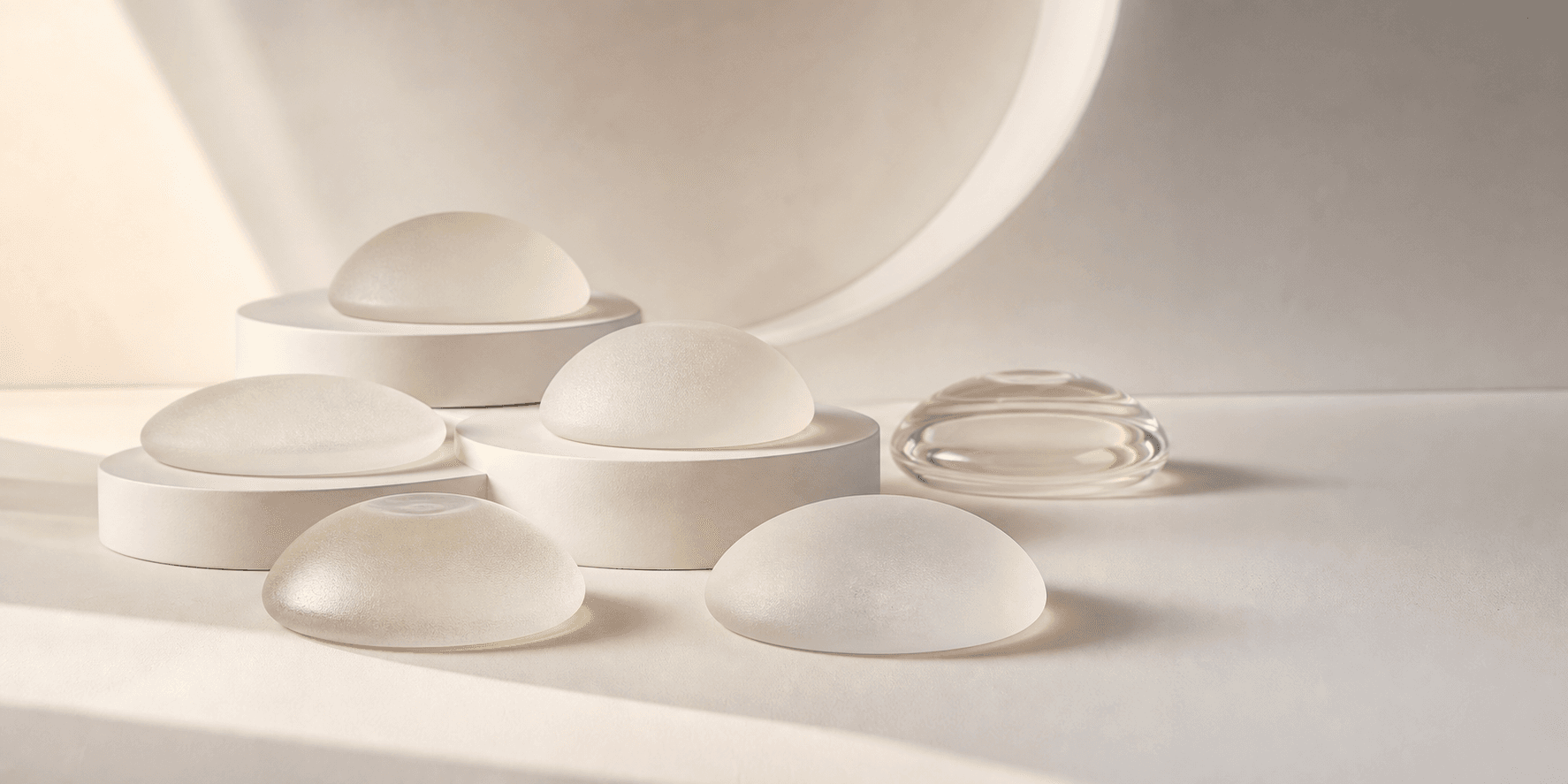
The right breast implant size is chosen from your chest and breast width, tissue thickness, skin stretch, and goals, not from a cc number. Two implants with the same volume can have different widths, projections, and gel behavior, so 350 cc can look modest on one chest and large on another. Width usually comes first, then the profile and volume that fit within it.
Implant selection is therefore a matching process, not a catalog preference. The goal is to choose dimensions and properties that support the desired proportion without asking the tissues to carry more than they can reasonably hold. The patient’s chest, natural tissue, skin, and nipple position remain the foundation.
How does implant width fit your chest?
Base width describes how much of the chest wall the implant occupies. It should be considered alongside the patient's breast width, cleavage spacing, rib shape, nipple position, and outer chest boundary.
An implant that is too narrow may create a projected central mound with limited side or lower-pole fill. One that is too wide may extend toward the armpit, narrow the cleavage space unnaturally, or place pressure on tissues beyond the breast footprint. Existing asymmetry can mean that the same implant behaves differently on each side.
Width is one reason volume should not be selected first. Once an appropriate footprint is defined, available profiles and volumes within that width become more meaningful.
Does a high-profile implant look fake?
Profile refers to how far an implant projects from the chest relative to its base. For a similar volume, a higher-profile implant is usually narrower and projects farther forward. A lower or moderate profile generally spreads volume across a wider base.
High profile does not automatically mean fake, and moderate profile does not guarantee natural. A narrow chest may need more projection to reach a desired volume without exceeding breast width. A wider chest may need a broader footprint for balanced coverage. Skin stretch, existing tissue, implant position, and the amount of volume selected shape the appearance.
Saline or silicone, and does gel firmness matter?
Saline implants have a silicone shell filled with sterile salt water. Their volume can be adjusted within the manufacturer's permitted range during surgery, and rupture is usually visible because the implant deflates. They may feel or ripple differently, especially when tissue coverage is thin.
Silicone implants contain gel with varying cohesivity. Softer gel tends to move and settle more readily. More cohesive gel may hold its shape and upper-pole contour more strongly, but can feel firmer. Cohesivity is not a simple ladder from bad to best. The choice depends on tissue thickness, skin envelope, shape goal, rippling risk, and the tradeoff between softness and form stability. The teardrop versus round implant guide explains how gel behavior changes the upright shape.
All implants have a silicone elastomer shell, including saline-filled devices. Implant fill does not determine every risk, and no implant is a lifetime device.
Does the implant surface affect safety?
Implant shells may be smooth or textured, although availability differs by market and manufacturer. Surface is not merely an aesthetic choice. Textured devices have been associated with a higher risk of breast implant-associated anaplastic large cell lymphoma, or BIA-ALCL, and certain textured implants have been recalled.
Patients should know the surface and model of any device being considered and keep the implant card after surgery. A new persistent swelling, mass, pain, or change around an implant deserves medical evaluation. The discussion should use current FDA labeling because device availability and safety information can change.
Are implant brands interchangeable?
Manufacturers offer different combinations of width, projection, gel cohesivity, shell design, warranty terms, and approved labeling. A moderate profile in one product line may not match the dimensions or feel of a moderate profile in another. Brand should be evaluated at the level of the specific model, not reputation alone.
Ask to review the manufacturer's patient labeling and the FDA-required decision checklist. The discussion should cover expected benefits, device-specific risks, rupture surveillance, warranty limits, and what happens if the preferred size is unavailable on the day of surgery.
Why do your tissues matter more than the implant?
The same implant can look different under thick versus thin tissue, above versus below the chest muscle, in a tight breast versus a stretched one, and with or without a lift. Pocket dimensions, fold position, chest-wall asymmetry, pregnancies, weight change, and healing affect the result.
An implant cannot reliably lift a low nipple or correct substantial loose skin. Increasing volume to avoid a needed lift can increase tissue strain, widen the pocket, and raise the risk of visible edges, rippling, bottoming out, or later revision. Sometimes a smaller implant with a lift creates a better balance than a larger implant alone.
Frequently Asked Questions
Can I choose by cup size or a friend's implant volume? No. Cup labels vary and another person's chest and tissues are different. Measurements, photographs, sizers, and a range of acceptable dimensions are more useful.
Does more cohesive gel prevent rippling? It may reduce visible folding in some situations, but tissue coverage, implant position, width, and pocket support also matter. No device can guarantee zero rippling.
Is one brand safest? Safety depends on the specific approved model, its surface and labeling, the patient's anatomy and health, surgical care, and long-term follow-up. Review current information rather than relying on a universal ranking.
Choose dimensions that fit your chest
If you are unsure what size would look proportionate on you, measurements and tissue assessment narrow the choice more reliably than a cc number or a friend’s result. Dr. Ruben Castro can measure the breast and chest, assess tissue thickness and skin, and translate your shape goals into an appropriate range of implant dimensions. The aim is not to choose the most dramatic specification. It is to select a device and surgical plan that work together with your anatomy.